LocalSpeakerTranscriber
Local pipeline that turns an audio recording into a transcript attributed to each speaker, without sending the audio to external services.
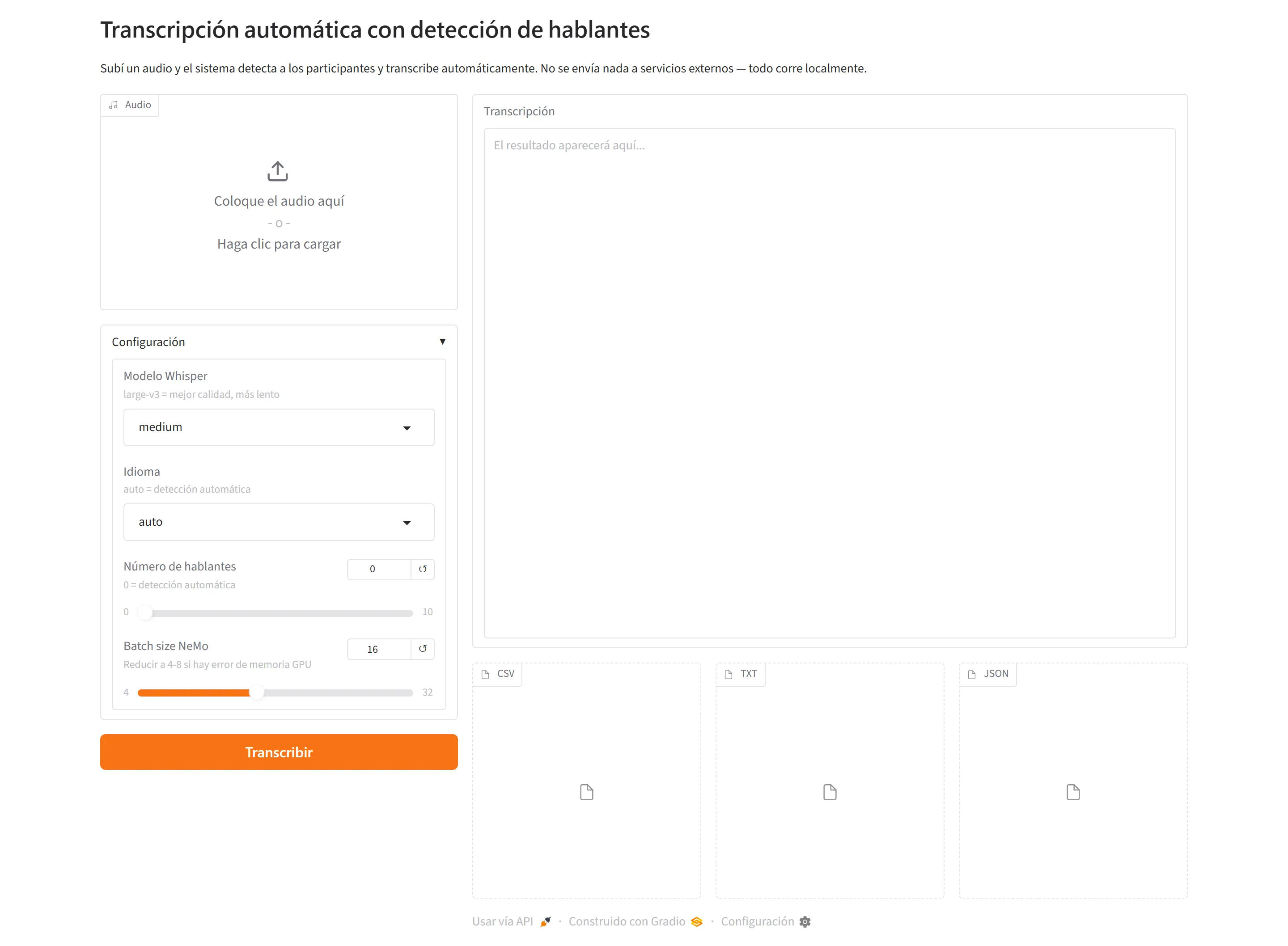
- Role
- Author
- Period
- Jun 2026
- Status
- Completed
- Stack
- Python
- faster-whisper
- NVIDIA NeMo
- Gradio
- ffmpeg
A personal tool. It takes a recording and produces a transcript in which every line carries a speaker, a timestamp and a confidence value. Everything runs locally; the models are downloaded once, on first use.
How it works
- Audio preparation.
ffprobeinspects the file andffmpegconverts it to 16 kHz mono, with a duration check afterwards. - Diarization. NVIDIA NeMo’s clustering diarizer decides who speaks when, using MarbleNet for voice activity, TitaNet embeddings and spectral clustering.
- Transcription. faster-whisper produces timed text segments.
- Alignment. This step is my own. For each text segment it adds up the overlap with every speaker and picks the largest. It records a confidence value, flags ambiguous segments together with the runner-up, and marks segments with no overlap as unknown.
- Outputs. A CSV, a JSON file, a Markdown report with each speaker’s share and low-confidence warnings, and a dialogue text file.
It has a command line with nine subcommands and a Gradio interface that listens on localhost only.
Engineering practice
- Machine-learning imports are lazy, so the command line, the alignment and the exports run and are tested without PyTorch.
- A Windows setup script with a CUDA or CPU switch, and a troubleshooting guide.
Limits
Speakers are attributed per segment, not per word, and overlapping speech is ignored. I have not published accuracy or speed figures. The models are NVIDIA’s and OpenAI’s Whisper; my work is the pipeline around them.